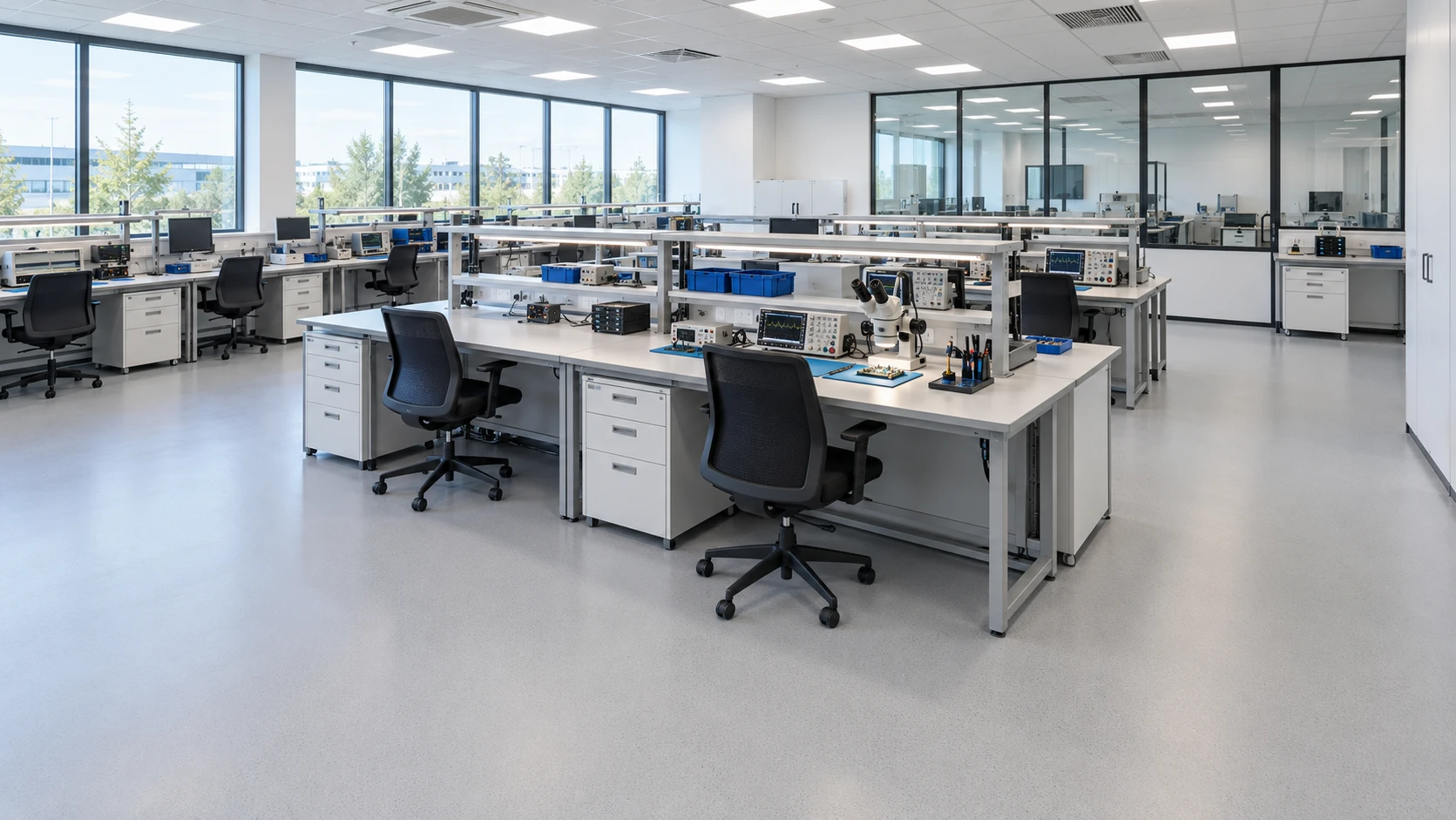
ESD Flooring and Workstations Explained

In electronics manufacturing, the way a space is designed can directly affect the products being developed, assembled and tested. Electrostatic discharge (ESD) can damage sensitive components, creating faults that may appear immediately or only become apparent later.

ESD flooring and workstations help manage this risk, but their effectiveness depends on how they fit into the wider facility. Grounding, workstation layout and the coordination of power, data and testing requirements all need to be considered early.

In this guide, we explain what ESD flooring and workstations do, and how to plan them into an electronics manufacturing environment.

What Is ESD Flooring?

ESD flooring is designed to provide a controlled path for static charge to dissipate to ground. Where it forms part of a personnel grounding system, it must work with suitable ESD footwear and verified grounding connections.

The flooring specification should reflect the activities taking place, the sensitivity of the components being handled and the organisation’s ESD control requirements.

It is also important to consider how the floor will perform in everyday use, including:

  • Equipment loads and trolley movements
  • Cleaning and maintenance requirements
  • Installation details and grounding connections
  • Compatibility with the selected footwear
  • Access for testing and ongoing checks

Choosing the flooring early allows these requirements to be coordinated with the layout and installation programme.

What Is an ESD Workstation?

An ESD workstation provides a controlled area for handling sensitive electronic components. It typically combines a suitable work surface with grounding arrangements and the equipment needed for the task.

Depending on the process, this may include wrist strap connections, monitoring equipment, suitable storage and tools, or ionisation where necessary.

The workstation also needs to function as a practical place to work. Bench dimensions, equipment positions, lighting and storage should support the operator without crowding the work surface.

For example, an assembly bench and a testing station may require different layouts, even when both sit within the same ESD protected area.

Flooring and Workstations Are Part of a Wider System

Installing ESD flooring or a specialist bench does not, by itself, establish an effective ESD protected area.

The overall control programme also needs to address personnel grounding, component handling, packaging, training and regular verification. The design should support those procedures and make them straightforward to follow.

This means defining where sensitive components will be unpacked, handled, stored and moved before the room layout is finalised. The organisation’s ESD lead should help establish the requirements alongside the design team and specialist suppliers.

Plan Grounding from the Outset

Grounding connects the relevant elements of the ESD control system so that charge can dissipate through the intended paths.

The arrangement needs to be coordinated across flooring, work surfaces, personnel grounding points and equipment. Connections should be accessible for inspection and testing, with clear responsibility for installation and verification.

Agreeing these details early helps avoid completed floors or benches needing alterations to accommodate connections that were overlooked during design.

Coordinate Power, Data and Testing Requirements

Electronics workstations often accommodate several pieces of equipment, each with its own service needs. Planning the bench without a clear equipment schedule can leave teams short of sockets, data connections or usable space.

Useful questions during the design stage include:

  • What equipment will be used at each workstation?
  • What power supplies and data connections are required?
  • Where will cables run?
  • Does testing require dedicated equipment or additional bench space?
  • What access is needed for maintenance and calibration?
  • How might the equipment arrangement change as production grows?

Resolving these questions before installation helps keep services accessible and work surfaces organised. It also allows the electrical design and ESD grounding requirements to be coordinated together.

Design the Layout Around the Process

A successful layout should reflect the sequence of work, from component receipt and storage through to assembly, inspection, testing and packing.

Positioning these activities deliberately can reduce unnecessary handling and make the boundaries of ESD protected areas clearer.

The design should allow sufficient space for operators, trolleys and maintenance access, while keeping frequently used tools and materials within convenient reach.

Where flexibility is required, consider how benches can be moved or expanded while maintaining the necessary services and verified ESD connections.

Common Mistakes to Avoid

Issues often arise when flooring, furniture and services are specified separately.

Common mistakes include:

  • Selecting flooring without checking the intended footwear and grounding system
  • Positioning benches before confirming equipment and service requirements
  • Overlooking routes for components moving between protected areas
  • Providing insufficient access for testing or maintenance
  • Changing the layout without reviewing the ESD arrangements
  • Leaving cleaning and ongoing verification out of the handover plan

Addressing these points during design helps reduce alterations and supports more reliable day-to-day operation.

How ParkLaine Supports Electronics Manufacturing Projects

At ParkLaine, we plan laboratory and technical environments around the people, equipment and processes they need to support.

Our design approach brings together space planning, furniture and building services, allowing specialist requirements to inform the project from the outset. For electronics manufacturing environments, this means coordinating the facility design with the client’s ESD requirements and specialist input.

By considering flooring, workstations and services together, we help create practical spaces that support current operations and future change.

Planning an Electronics Manufacturing Facility?

Whether you are developing a new facility or refurbishing an existing space, early coordination of ESD flooring, workstations and services helps establish a clear brief for delivery.

Explore our Laboratory Design & Consultancy service, or contact our team to discuss your project.

Have a project in mind?

From future-ready workspaces to technically complex laboratories, ParkLaine delivers interiors engineered for excellence. Tell us about your next project and our team will be in touch to explore how we can support you.
Download the ParkLaine 2026 brochure here!

Logo icon