This article explores key trends shaping laboratory design in 2025, including flexibility, compliance, digital integration, workflow efficiency, and sustainability, with insights on how modern labs are evolving to meet new demands.
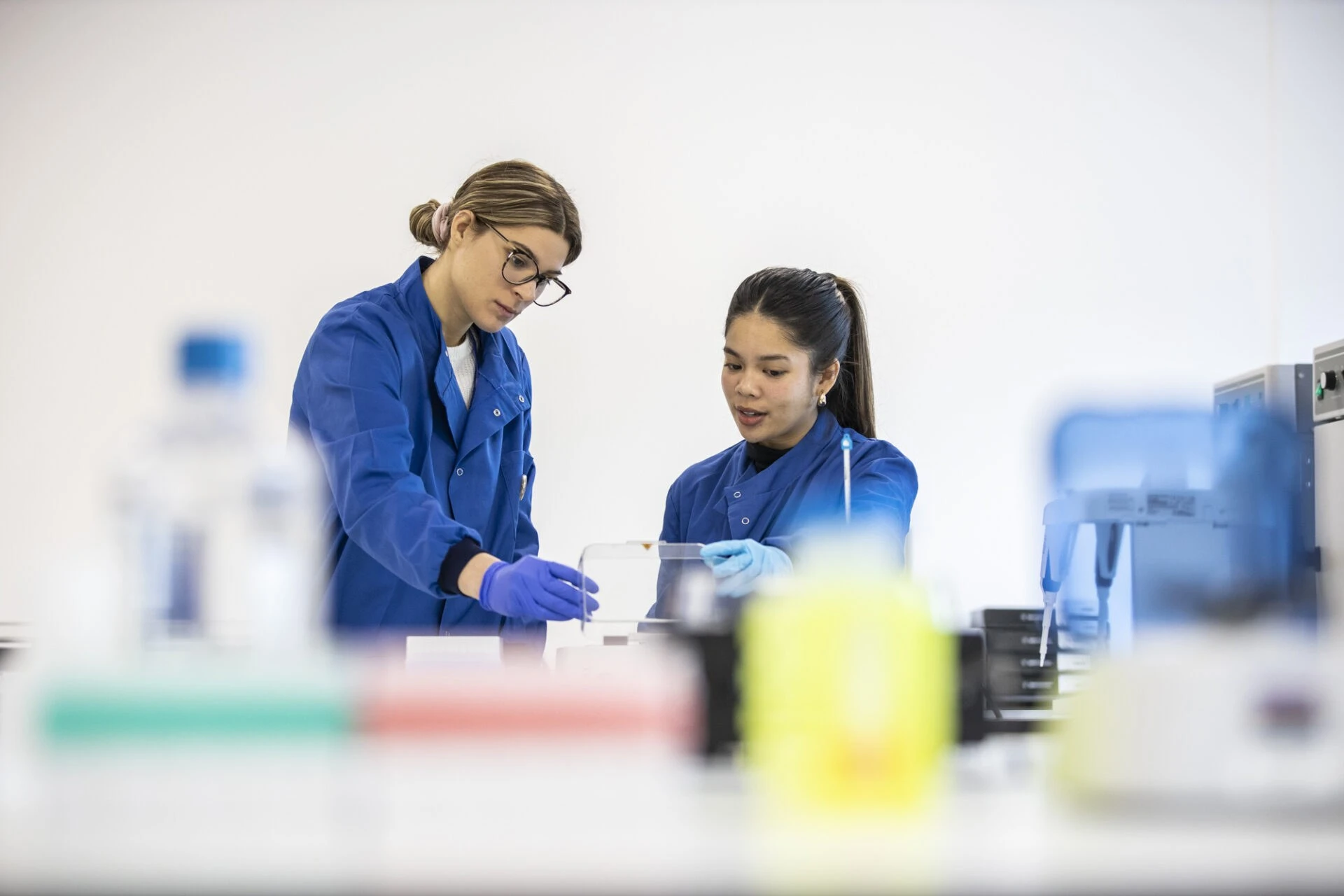
World-Class Laboratory Design
The design and construction of laboratory environments in 2025 must meet a new standard. As industries ranging from pharmaceuticals and biotech to materials science and diagnostics face increased pressure to innovate, the spaces in which they operate must offer more than compliance and containment — they must be adaptable, intelligent, and built to support people, process, and performance.
At ParkLaine, we bring a multidisciplinary approach to laboratory design and delivery, underpinned by sector expertise and the latest trends. We create spaces that are not only high-performing and future-ready but that genuinely empower science.
1. Flexibility: A Strategic Priority
Modern laboratories are shifting from fixed-use layouts to dynamic, reconfigurable environments. According to JLL’s 2025 Life Sciences Real Estate Outlook, 82% of UK lab occupiers now cite flexibility as a critical feature in new builds or refurbishments.
To support this, ParkLaine designs spaces with:
- Modular benching and mobile casework that can be reconfigured by users
- Ceiling-mounted service spines with drop-down utility points
- Movable partitions that allow zones to be redefined without structural change
- Shared support spaces such as equipment rooms and clean utility zones
This flexibility is vital not only for fast-moving R&D but also for facilities that evolve from research to pilot-scale production, supporting long-term return on investment.
2. Compliance as a Built-In Feature
With regulatory oversight increasing globally, particularly in controlled environments, lab compliance must be embedded from the outset. For example, MHRA inspection activity rose over 30% in 2024, reflecting a greater focus on HVAC validation, contamination control, and data integrity.
ParkLaine integrates compliance into the design and build process through:
- Early engagement with QA/QC leads to define regulatory pathways
- Defined clean/dirty and personnel/material flows
- Zoned pressurisation and air handling strategies
- GMP-compliant materials and easy-to-clean finishes
- Support for data traceability with systems-ready infrastructure
This ensures clients pass audits with confidence and avoid costly redesigns post-construction — a risk all too common when compliance is treated as an afterthought.
3. Digital Integration and Smart Lab Infrastructure
Laboratories in 2025 rely on a growing ecosystem of digital tools, automation platforms, and connected devices. Over 65% of new UK lab developments now include digital infrastructure for building systems and lab automation, according to the Savills Life Sciences Report (Q1 2025).
At ParkLaine, we deliver labs that are smart from the inside out, featuring:
- Integrated Building Management Systems (BMS) with remote control of HVAC, lighting, and alarms
- IoT-enabled monitoring for temperature, humidity, fume hood usage, and equipment status
- Data-ready cabling and secure server integration for LIMS, ELNs, and other lab software
- Cloud-based alerts for equipment failures, safety breaches, or compliance events
- Energy and performance dashboards accessible to facilities teams and researchers
This digital backbone not only improves operational efficiency but supports 24/7 research operations and remote lab management — increasingly vital in hybrid and global R&D models.
4. Workflow Efficiency and Process-Driven Design
In high-performance laboratories, how space is organised has a direct impact on the speed, accuracy, and safety of scientific work. Poorly planned adjacencies, unclear flows, or bottlenecks in support areas can slow down research and introduce unnecessary risk. In 2025, lab users are placing increasing emphasis on workflow optimisation — not just fit-out quality.
At ParkLaine, we design every laboratory around the real-world processes that take place inside. We achieve this through:
- Process mapping during design development, involving scientific and technical leads
- Zoning layouts that support separation of wet and dry work, clean and dirty processes, or high-risk and low-risk areas
- Logical adjacencies between write-up, prep, lab, and equipment rooms
- Efficient circulation routes for personnel and materials, minimising cross-traffic and contamination risk
- Dedicated sample receipt, waste handling, and utility corridors to support SOPs and regulatory needs
This focus on operational logic results in safer, more productive environments where teams can move confidently and processes can be standardised and scaled.
5. Speed to Market: Efficient Delivery Without Compromise
The demand for high-quality laboratory space across the UK’s science and innovation clusters is outpacing supply. In areas such as the Oxford-Cambridge Arc, Manchester, and London’s life sciences hubs, vacancy rates for fitted lab space remain below 3% — driving urgency for fast, high-quality delivery.
ParkLaine meets this need through a streamlined, single-point design-and-build process. We reduce programme times by up to 25% compared to traditional procurement routes, without sacrificing quality or compliance.
Our delivery process includes:
- Early-stage feasibility and spatial planning
- Rapid design development using 3D modelling and clash detection
- Close coordination with services and equipment vendors
- On-site construction managed by experienced project leads
- Commissioning and validation support for seamless handover
By integrating all stages of the process, we give clients tighter control of risk, cost, and timeline — which is essential in capital-sensitive R&D and production environments.
6. Supporting Sustainability Without Compromising Performance
While laboratories are inherently energy-intensive, there is growing pressure from clients, investors, and regulators to reduce operational emissions. Laboratories typically consume 3 to 5 times more energy per square metre than commercial offices (UK Green Building Council, 2024), largely due to HVAC systems and 24/7 equipment loads.
ParkLaine balances performance and sustainability through:
- High-efficiency air handling systems with heat recovery and variable volume control
- LED lighting and daylight harvesting controls
- Energy sub-metering for different zones and systems
- Low-carbon materials where specification allows (e.g., recycled steel, FSC-certified timber)
- Support for BREEAM ‘Excellent’ and NABERS targets
While sustainability isn’t the sole focus of our designs, it remains a key area of value engineering and futureproofing for long-term asset performance.
Conclusion: Building Spaces That Enable Science
In 2025, world-class laboratory design is about enabling capability — not just compliance. Whether it’s adaptability to new science, readiness for regulatory scrutiny, or the digital backbone to support real-time operations, laboratories must perform at a higher level than ever before.
At ParkLaine, we combine technical expertise with commercial insight and delivery certainty. Our team understands the science behind the space — and the business case behind the build.
If you’re planning a new facility, refurbishing an existing asset, or scaling up for new programmes, we’re ready to help you create a space that delivers.
Let’s build the future of science together.
Contact ParkLaine to discuss your next laboratory project.
☎️0333 242 0640
📧hello@parklaine.co.uk
www.parklaine.co.uk
Have a project in mind?
From future-ready workspaces to technically complex laboratories, ParkLaine delivers environments engineered for excellence. Tell us about your next project and our team will be in touch to explore how we can support you.